Fashion has always developed a particular fascination with women whose presence extends beyond clothing itself. Certain personalities enter the industry through campaigns or runways and eventually evolve into something much larger: cultural figures whose image becomes immediately recognizable across generations. Trends may change constantly, though women with a clearly defined identity often remain relevant far longer than any season. Fashion repeatedly returns to personality because personality creates memory.
For decades, Heidi Klum occupied precisely that space. Long before conversations surrounding personal branding, multi-platform careers, or entrepreneurial influence became standard industry language, Heidi had already begun building a trajectory extending far beyond modeling itself. What initially started in Germany during the early 1990s after winning a national modeling competition gradually developed into one of the most recognizable international careers in fashion and entertainment. Her rise coincided with the era of global supermodels, a period where fashion created personalities capable of becoming larger than the industry surrounding them. Yet unlike many names associated with that generation, Heidi continuously expanded her identity instead of remaining confined within one category.
Magazine covers quickly followed, major campaigns arrived, and eventually Victoria’s Secret transformed her into one of the defining faces of an entire period in fashion history. During the late 1990s and early 2000s, Heidi became part of a generation of women whose visibility extended well beyond traditional modeling circles. Yet while fashion often rewards image alone, Heidi developed a considerably more personal relationship with public attention. Her appeal never relied entirely on distance or mystery. Audiences connected with her because she projected something highly recognizable: energy.
That quality followed her throughout every stage of her career. Whether appearing on red carpets, television screens, interviews, campaigns, or fashion productions, Heidi maintained a personality built around spontaneity, confidence, humor, and an unusual ability to make visibility appear natural. Public culture frequently creates famous faces. Creating familiarity operates differently.
Over time, Heidi began transforming visibility into structure. Instead of allowing fashion to define the limits of her career, she gradually expanded into entertainment and business, creating one of the strongest transitions from supermodel into media personality of her generation. Project Runway became a major cultural phenomenon and fundamentally changed the relationship between television and fashion, eventually earning Heidi an Emmy Award. Years later, Germany’s Next Topmodel introduced another chapter, placing her at the center of fashion conversations for entirely new audiences.
What made this evolution particularly interesting was its consistency. Many careers change direction dramatically from one chapter to another. Heidi’s trajectory always felt connected. Fashion informed entertainment. Entertainment expanded influence. Influence created opportunities for entrepreneurship and long-term visibility. The movement always appeared organic.
Part of her longevity also comes from adaptability. Entire media systems transformed during the years her career developed. Fashion itself changed repeatedly. Audiences changed. Platforms changed. Yet Heidi continuously adjusted without losing the personality audiences associated with her from the beginning. Women increasingly followed not simply what she wore, but the confidence with which she moved through different spaces.
Perhaps this explains why her newest collaboration with AIGNER feels remarkably natural.
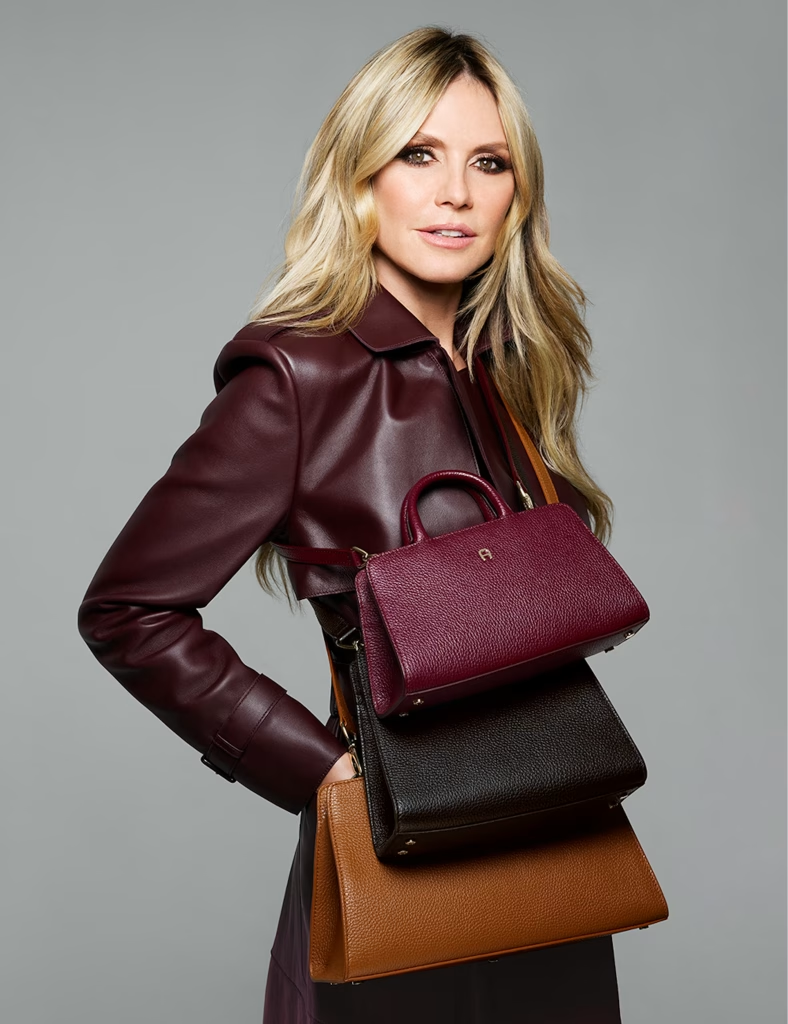
The House recently introduced Heidi Klum as its new global testimonial, a partnership centered around ideas already closely connected with her own public identity: individuality, confidence, and personal expression. Rather than presenting a campaign built around a constructed image, AIGNER allows Heidi’s own personality to remain central.
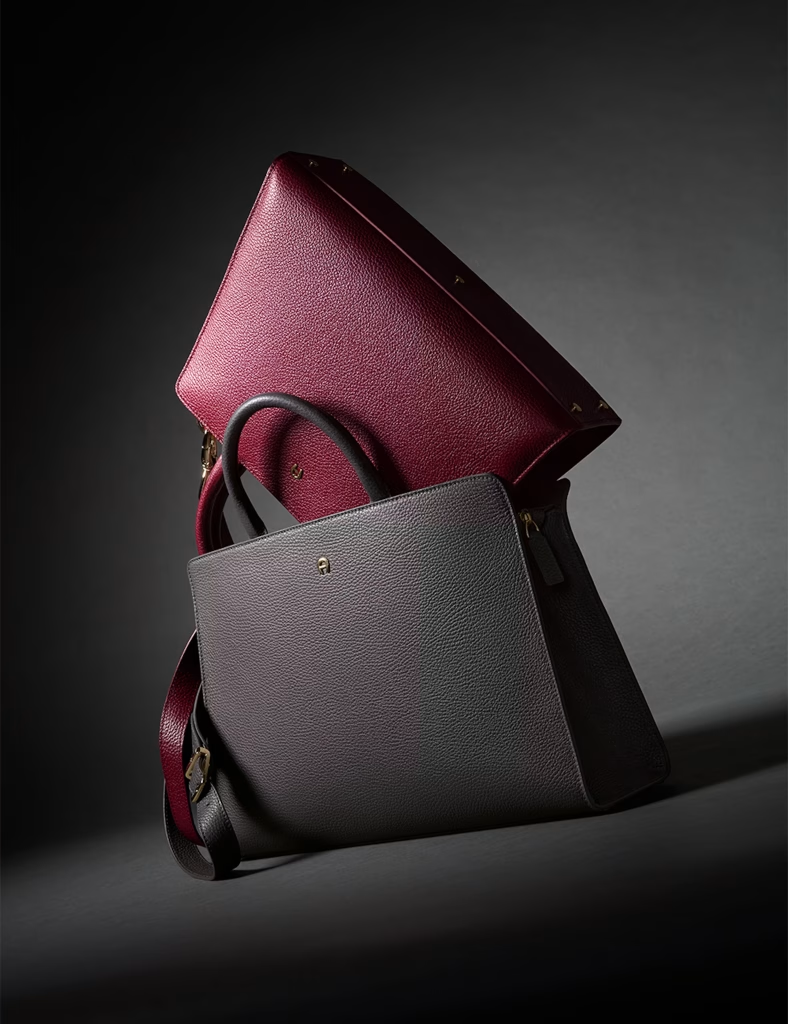
Photographed by Rankin in Los Angeles, the Fall/Winter 2025 campaign introduces six looks selected personally by Heidi from the collection. The styling immediately feels highly personal because it reflects her own preferences rather than a rigid campaign narrative. Signature AIGNER pieces, including the CYBILL Bag in Black, Burgundy, and Cognac, appear alongside a dark-red leather trench coat creating one of the collection’s strongest visual moments.
Her personal favorite remains the CARRÉ SOFT Bag in Cognac, a design Heidi described through its exceptionally soft leather and woven handle details. Elsewhere, her styling introduces stronger and more playful contrasts. The FARAH Bag appears with deep burgundy outerwear, while the MIRANDA Bucket Bag enters alongside charms, bandanas, oversized bouclé textures, leather details, and movement.