Red carpet fashion changed dramatically over the last decade. It no longer functions as a simple arrival moment before a film premiere or award ceremony. Today, it operates as one of fashion’s most visible stages, where celebrity image, archive dressing, luxury houses, and visual storytelling intersect under global attention. According to data from media intelligence platform Launchmetrics, major red carpet appearances and celebrity placements can generate millions of dollars in Media Impact Value for luxury brands, confirming how powerful fashion visibility has become. One appearance. Hundreds of cameras. Global circulation within minutes.
The relationship between celebrities and fashion also became significantly more strategic. Stylists, fashion houses, and archives increasingly work together to create moments designed to travel beyond the staircase itself. Cannes demonstrates this particularly well. Cinema remains the official reason people arrive, yet fashion repeatedly becomes part of the larger narrative. And one question continues appearing every year: who truly owns a red carpet moment — the person wearing the dress, or the dress itself?
Very few houses understand visual impact better than Roberto Cavalli. Founded by Roberto Cavalli in Florence during the early 1970s, the brand developed a design language immediately recognizable through sensual silhouettes, rich textures, and an unapologetic approach to glamour. Cavalli became widely known after developing innovative leather printing techniques that transformed traditional materials into fashion statements. Over time, the House built a visual identity around exotic references, intricate embellishment, and silhouettes designed to command attention.
Celebrity culture became central to the brand’s evolution. Throughout the years, Roberto Cavalli dressed musicians, actresses, supermodels, and public figures whose image aligned naturally with the House’s visual energy. Animal prints became signatures. Embroidery became signatures. Confidence itself became part of the design language. Fashion often moved toward minimalism; Cavalli rarely followed.
The archive today occupies an especially important role because fashion increasingly looks backward while searching for new relevance. Designers revisit earlier decades. Stylists search historical collections. Vintage and archive dressing entered a completely new chapter in celebrity culture because originality now frequently comes from rediscovery rather than novelty. Fashion constantly introduces something new, though audiences continue returning to pieces carrying history.
Taylor Hill built one of the most recognizable modeling careers of her generation after entering the industry at a remarkably young age. International visibility arrived through her work with Victoria’s Secret, where she later became one of the youngest official Angels. Her career expanded quickly across runway work, beauty campaigns, luxury editorials, and major international covers. Hill developed an unusual balance between commercial success and fashion credibility, moving easily between high-profile campaigns and editorial projects.
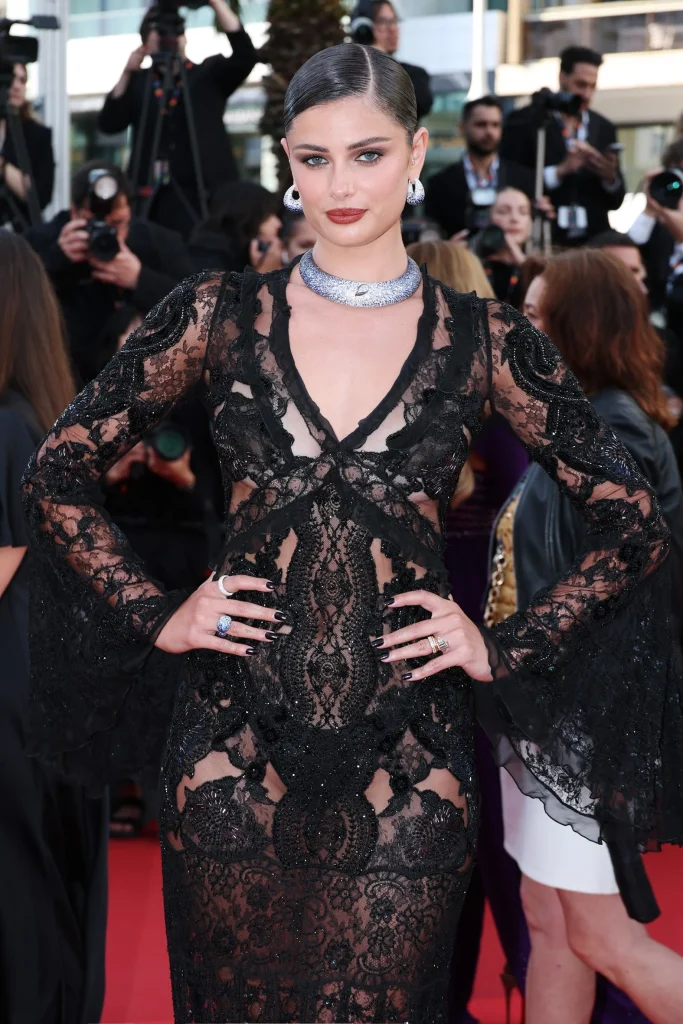
For the “Fjord” screening during the 79th Cannes Film Festival, Taylor Hill selected Roberto Cavalli Archive for an appearance that immediately captured attention. The look featured a sheer black lace mermaid gown constructed around a dramatic plunging neckline and elongated flared sleeves. Tonal jet beading and sequin embroidery introduced depth across the silhouette, while transparent lace inserts created movement and visual contrast throughout the design.