Entertainment, luxury, and modern lifestyle increasingly move through the same world. The strongest experiences today rarely belong to one category alone because people no longer separate performance from comfort or design from emotion. Cars, hotels, travel, fashion, and technology increasingly speak a similar language built around experience itself. Recent findings from Deloitte’s Global Automotive Consumer Study revealed that approximately 61% of premium consumers now place stronger emphasis on elevated in-car experiences and comfort technologies alongside performance expectations, reflecting a broader shift in luxury behavior. The destination itself still matters, though increasingly people remember how something made them feel along the journey. And when movement itself begins becoming part of the entertainment, where exactly does travel end and lifestyle begin?
For Aston Martin, that conversation began long before luxury performance became one of the industry’s defining themes. Twenty-five years ago this month, the British marque introduced the V12 Vanquish and presented a model that immediately represented a different level of ambition. It arrived not simply as a new sports car but as a statement surrounding what Aston Martin believed performance, technology, and grand touring could become. At the time of its unveiling, the V12 Vanquish represented the most sophisticated and technologically advanced sports car the company had ever designed and produced, introducing an entirely new chapter that would eventually define the next quarter century of the brand’s history.
Today, across three distinct generations, Vanquish continues occupying a unique position inside Aston Martin’s universe. It remains the flagship expression of the marque’s front-engined sports car philosophy and a model carrying a particular emotional significance for both the company and collectors who followed its evolution. Aston Martin CEO Adrian Hallmark recently described the Vanquish name as something synonymous with ambition, individuality, and bold thinking. Looking back across twenty-five years, it becomes easy to understand why.
The first chapter officially began at the 2001 Geneva Motor Show, where Aston Martin introduced the first model to wear the Vanquish name. Looking at its specifications today still reveals how progressive the project felt during its era. Features such as drive-by-wire throttle technology and Formula One-inspired fingertip paddle shifters represented substantial innovations for Aston Martin at the time and immediately positioned the company within a far more technologically advanced conversation.
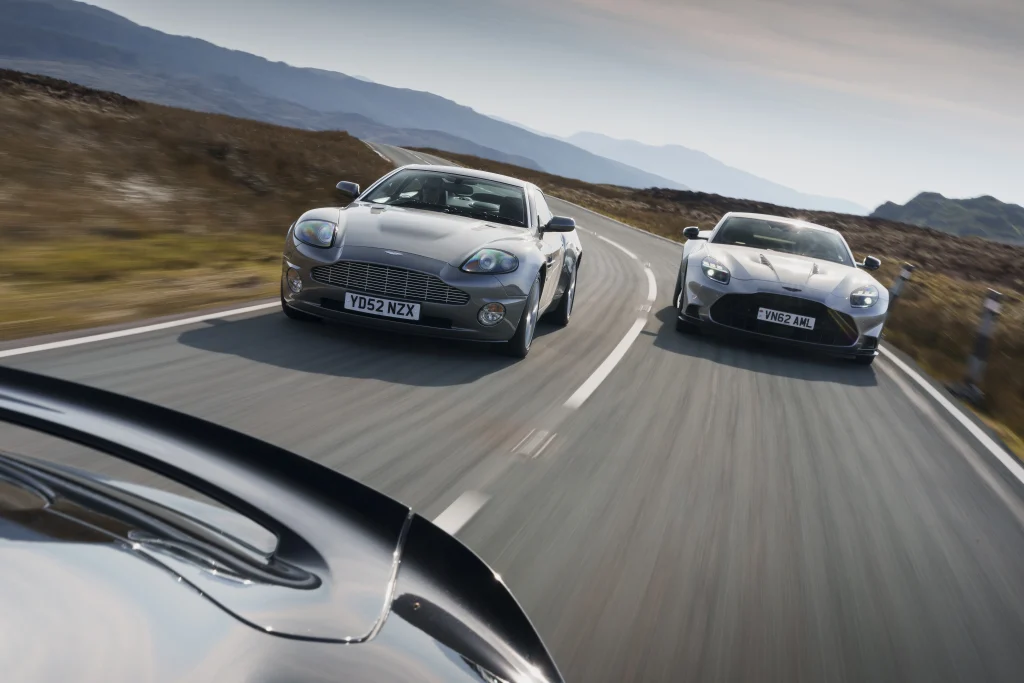
Beneath the bonnet sat a new 6.0-litre V12 producing 460 horsepower paired with an F1-style paddle-shift gearbox. Yet the story extended beyond performance figures alone. The engineering structure itself introduced a major leap forward. Aluminum body architecture, carbon-fibre transmission tunnels, composite structures, and highly advanced manufacturing methods fundamentally changed Aston Martin’s production philosophy. Creating these systems required entirely new precision-controlled processes developed through collaborations involving Silicon Valley in California and the University of Nottingham in the United Kingdom. The car therefore represented not only a design evolution but a technological one.
Response from both customers and media arrived quickly. Praise surrounding the V12 Vanquish extended beyond speed and design because the model immediately established a stronger sense of ambition around the future direction of the company itself. Subsequent versions including the Vanquish S and Ultimate Edition only reinforced its growing status throughout the early years of the century.
When the second generation Vanquish arrived in 2012, Aston Martin once again expanded the identity surrounding the model. Design moved into a sharper and more aggressive direction influenced heavily by the One-77 hypercar. Carbon fibre became central to the vehicle’s construction, with every exterior panel produced using aerospace-grade materials that reduced overall body weight by approximately twenty-five percent compared with the DBS model it replaced.
Performance evolved equally. The revised 6.0-litre V12 delivered 565 horsepower and produced acceleration figures capable of reaching 62 miles per hour in only 4.1 seconds before continuing toward a top speed of 183 miles per hour. Carbon Ceramic Matrix braking systems improved thermal resistance and performance under demanding driving conditions while maintaining grand touring refinement. Yet one aspect always distinguished Vanquish from many performance competitors. Practicality remained part of the philosophy. Seating layouts offered both 2+0 and 2+2 configurations, while luggage capacity reached 368 litres. The car continuously balanced power with comfort, preserving Aston Martin’s long-standing understanding of grand touring itself.
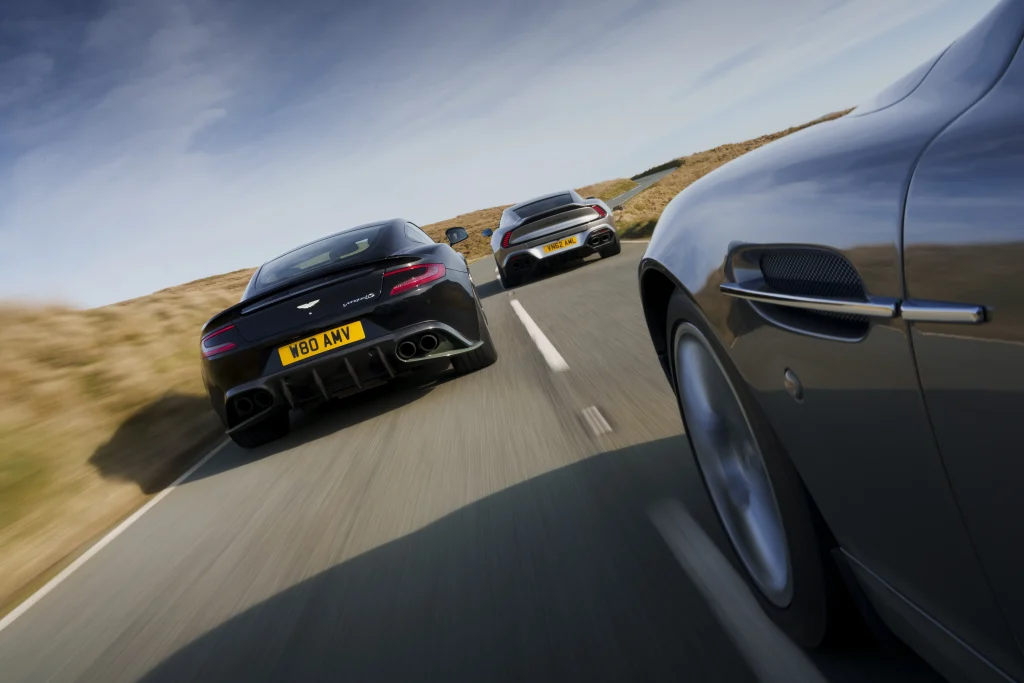
The newest chapter arrived in 2024 and immediately pushed Vanquish into entirely new territory. Powered by a 5.2-litre Twin-Turbo V12 producing an extraordinary 835PS and 1000Nm of torque, the current Vanquish became the most powerful flagship Aston Martin had ever introduced. Acceleration from zero to sixty miles per hour now arrives in only 3.3 seconds, while a top speed of 214 miles per hour established a new benchmark as the fastest series-production Aston Martin created at launch. The engineering surrounding the newest generation extends equally far. Carbon-fibre bodywork, a bespoke chassis architecture, Carbon Ceramic Brakes capable of operating at temperatures approaching 800 degrees, and highly advanced suspension technologies all reinforce the technical depth of the model. Production also remains deliberately restricted to fewer than one thousand examples annually, preserving exclusivity within the ultra-luxury segment.
Still, perhaps the most interesting aspect surrounding Vanquish never belonged entirely to horsepower, materials, or technical specifications. Across twenty-five years and three generations, Aston Martin repeatedly preserved something considerably more difficult to engineer: character. Many automotive icons evolve until little remains of their original identity. Vanquish continuously moved forward while preserving the emotional ambition that defined its first appearance in Geneva all those years ago.