Jewellery and watchmaking increasingly occupy shared territory. The distinction between adornment and engineering gradually became less defined as collectors increasingly search for objects combining technical complexity with emotional and visual impact. According to recent global market projections, the jewelry industry is expected to grow at an annual rate of approximately 5.4% over the coming years, driven largely by increasing demand for exceptional craftsmanship and collectible luxury pieces. Precision still matters. Beauty continues mattering too. But when technical mastery becomes visually captivating, does a timepiece begin behaving like jewelry itself?
That conversation enters a remarkable new chapter through the Duometre Heliotourbillon Perpetual in platinum from Jaeger-LeCoultre. Produced in an exceptionally limited series of only twenty pieces, the latest interpretation of the House’s celebrated Duometre concept approaches high watchmaking through an object that feels almost sculptural in presence. Mechanical sophistication remains central, though visual elegance appears equally important.
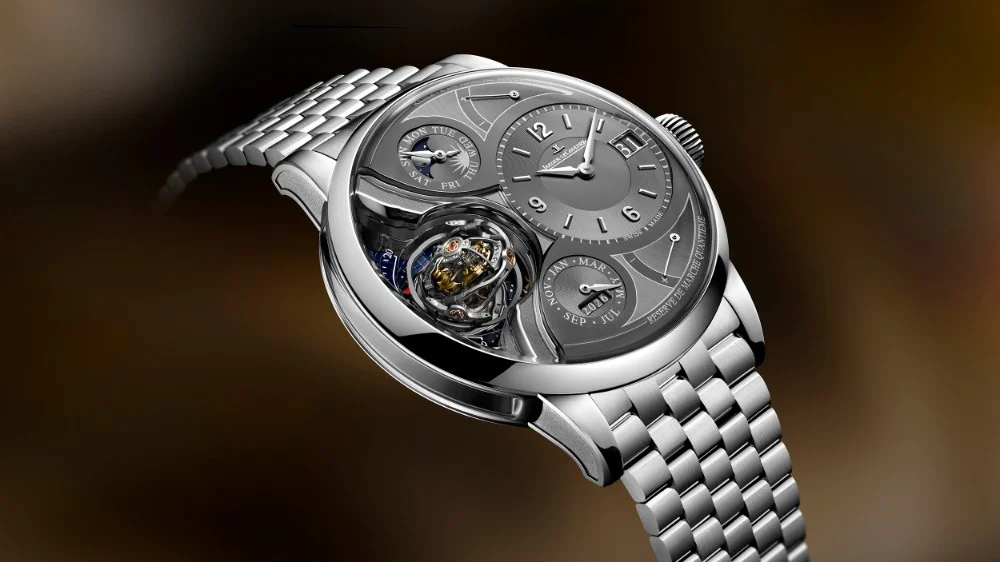
Platinum immediately shapes the identity of the piece. Long associated with rarity and understated prestige, the metal introduces a monochromatic direction extending beyond the case itself through a new bracelet executed entirely in platinum 950/1000. The effect feels clean and highly restrained while allowing light, movement, and mechanical details to remain central. Certain materials naturally attract attention through brilliance. Platinum operates differently. It communicates through discretion.
Yet the strongest visual and technical element remains the Heliotourbillon itself. Positioned at the heart of the watch, the construction introduces a tri-axial tourbillon mechanism designed as a constantly shifting kinetic structure. Movement unfolds continuously across multiple axes, creating an almost hypnotic effect. Precision remains its technical purpose, though visually the mechanism behaves more like choreography.
There is something unexpectedly poetic about the motion itself. Traditional tourbillons already occupy a special place inside watchmaking. A tri-axial construction introduces another level entirely, allowing movement to become considerably more dynamic and expressive. Engineering and spectacle briefly occupy the same space.

Inside the piece operates Calibre 388, combining Jaeger-LeCoultre’s Duometre architecture with a perpetual calendar and large date complication. Complexity here never feels excessive. Instead, multiple functions appear carefully balanced through structure and organization. Technical depth remains visible, though never overwhelming. The Duometre concept itself historically developed around one central ambition: greater precision through separation. Two independent mechanisms share one regulating organ, creating an architecture designed to improve timekeeping while maintaining energy efficiency. Technical innovation frequently remains hidden beneath surfaces. Here, the construction becomes part of the visual language itself.
Perhaps that remains one of the strongest aspects of contemporary high watchmaking and high jewelry alike. Objects increasingly operate beyond practical purpose. They become expressions of identity, craftsmanship, and emotion. A watch still measures time. Jewelry still decorates. Yet pieces like the Duometre Heliotourbillon Perpetual quietly ask another question entirely.
What happens when complexity itself becomes beautiful?