Fashion changes its rhythm as fall approaches. The season traditionally brings a return to stronger silhouettes, richer textures, and wardrobes that rely less on spontaneity and more on construction. Summer often allows simplicity; fall asks for intention. Outerwear regains authority, tailoring becomes sharper, and materials begin carrying as much visual weight as color itself. It is also the period when fashion imagery becomes especially influential, as campaigns and look releases begin shaping the visual mood of the months ahead.
Saint Laurent has spent decades understanding precisely that language. Founded in 1961 by Yves Saint Laurent and Pierre Bergé, the House repeatedly altered fashion history through ideas that fundamentally changed women’s wardrobes. Yves Saint Laurent introduced Le Smoking in 1966 and transformed the tuxedo into one of fashion’s most powerful statements for women. He was also among the first couturiers to look toward street culture, travel, art, and youth movements as sources of inspiration long before those conversations became industry standards. Even decades later, Saint Laurent continues existing in a category very few houses truly reach: immediately recognizable, culturally influential, and visually disciplined.
For Women’s Fall 2026, Creative Director @anthonyvaccarello continues developing a visual world built around precision, tension, and a very specific understanding of female presence. Photographed by Talia Chetrit and centered around Frankie Rayder, the campaign avoids dramatic scenery and visual overload. Instead, the images create impact through atmosphere, proportion, and attitude. There is a quiet confidence throughout the series that immediately recalls one of Saint Laurent’s strongest characteristics: power that never needs to announce itself loudly.
The imagery itself operates through contrast. Looking closely, the collection repeatedly places softness beside structure and intimacy beside strength. In one frame, oversized glossy black outerwear with an exaggerated fur collar creates a strong architectural shape around the body, while sheer underlayers and delicate details introduce vulnerability and tension at the same time. The proportions appear intentionally exaggerated yet carefully controlled. Nothing feels accidental.
The large fur collar becomes particularly important visually because it transforms the silhouette entirely. It introduces volume around the shoulders and face while directing attention upward toward expression rather than decoration. Frankie Rayder wears it with complete restraint, allowing posture and attitude to shape the image. This is not styling dependent on movement or excess accessories. The confidence comes through stillness. Elsewhere, transparency becomes another recurring language. Fine lace, fitted silhouettes, sheer textures, and sharply cut lines introduce a conversation between exposure and concealment that Anthony Vaccarello frequently revisits throughout his work. Saint Laurent under Vaccarello repeatedly explores the idea that strength and sensuality rarely exist as opposites. Instead, they frequently operate side by side.
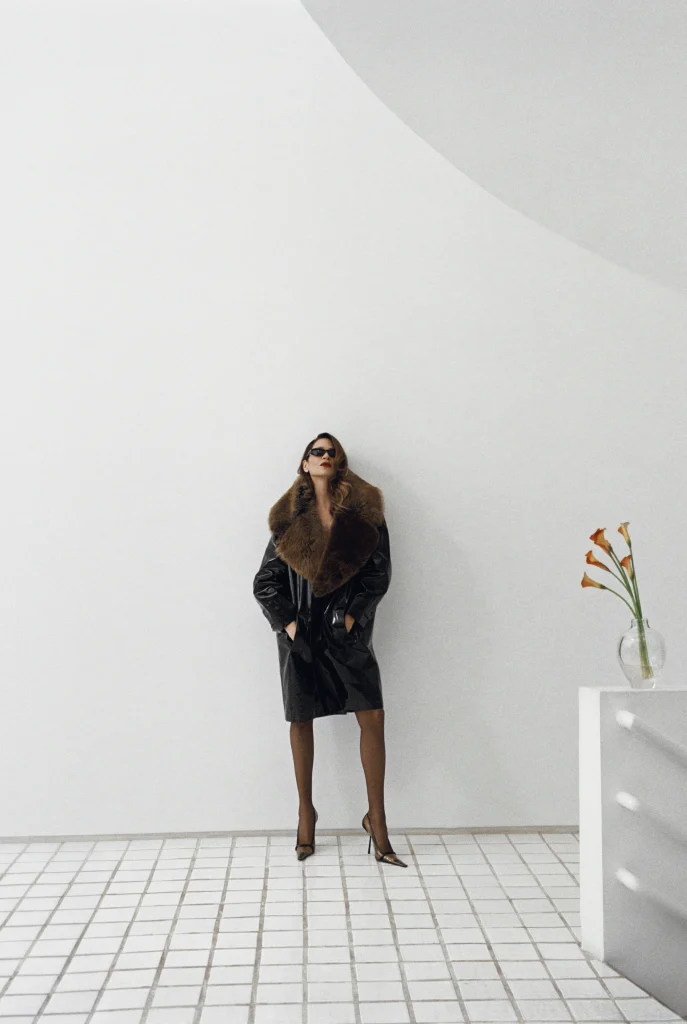
Talia Chetrit’s photography strengthens that tension further. The images feel intimate but never intrusive, controlled without appearing rigid. Certain frames almost resemble discovered moments rather than traditional campaign photography. Others feel closer to portraits than fashion images. The architectural setting itself remains intentionally minimal, allowing silhouettes and body language to dominate the visual narrative.
Frankie Rayder also brings particular significance to the campaign. Throughout her career, she represented a generation of models whose presence relied less on theatrical performance and more on character. That quality becomes important here because these images never appear focused on clothing alone. They focus equally on the woman wearing them.
Anthony Vaccarello continues showing a very precise understanding of Saint Laurent. Rather than constantly reinventing the House identity, he refines and sharpens it season after season. Strong shoulders remain. Precision remains. Sensuality remains. Yet each collection introduces subtle shifts that allow the language to evolve without losing familiarity.