Few countries transformed aviation into a national language as successfully as the United Arab Emirates. Airports there were never designed merely as points of departure and arrival; they became economic engines, symbols of ambition, and instruments of international influence. In only a few decades, the UAE shifted from a regional transit destination into one of the world’s central aviation hubs, creating a model in which connectivity itself became part of the country’s identity. According to data from the International Air Transport Association, aviation and aviation-related tourism contributed approximately 92 billion dollars to the UAE economy in 2023, representing 18.2 percent of national GDP and supporting nearly one million jobs. Numbers of that scale reveal something larger than economic success. They reveal infrastructure transformed into strategy.
Within that story, one name repeatedly appears at the center of the conversation: Emirates. Over decades, Emirates developed a reputation extending well beyond aircraft and destinations. Its international growth built a recognizable image associated with service, global reach, and a carefully maintained relationship with luxury, hospitality, and sport. Yet companies increasingly operate in a different cultural environment today. Growth statistics, passenger numbers, and financial performance remain important, certainly, though another question has entered modern corporate thinking: what role should a company play in the everyday lives of its employees?
That philosophy became particularly visible through the Emirates Group’s participation in the Dubai Fitness Challenge, a citywide initiative encouraging participants to dedicate thirty minutes to physical activity daily over thirty consecutive days. More than 22,000 Emirates Group employees participated in the 2025 edition, making the company one of the initiative’s largest corporate contributors according to official challenge data. For a workforce of that scale, participation stops feeling symbolic and begins revealing something about culture itself.
To encourage involvement, Emirates once again introduced an additional incentive that connected movement with the company’s own identity: employees who successfully completed the challenge received a complimentary Service-Related Concession ticket valid across destinations on the Emirates network. It was a practical decision, though also an intelligent one. Movement rewarding movement.
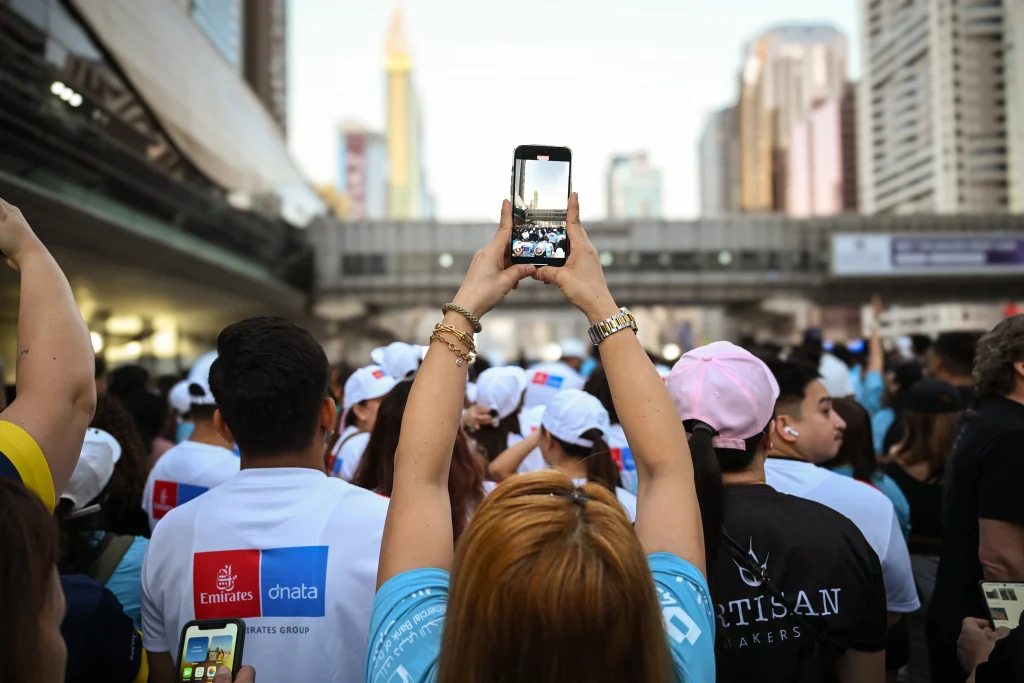
Participation stretched far beyond a single event. More than 2,000 employees joined Dubai Run, taking over Sheikh Zayed Road alongside friends, colleagues, and family members. For several hours, one of Dubai’s busiest and most recognizable roads exchanged traffic for runners and transformed into something entirely different — a shared public space dedicated to activity, community, and collective energy.
The image itself carried a certain significance. Cities often reveal themselves differently when routine disappears. Roads associated with speed suddenly become places for conversation. Corporate structures become communities. Professional environments become human ones.
Beyond Dubai Run, employees also participated in Dubai Ride and Dubai Stand-Up Paddle, while thirty internal sports and hobby clubs remained active throughout the month, offering activities ranging from football and cricket to basketball, cycling, and volleyball. The objective remained straightforward: thirty active minutes a day or ten thousand steps. The Group additionally hosted dedicated wellness activations at Zabeel Park, where fitness sessions and interactive activities encouraged participation outside traditional workplace environments. What emerged from these initiatives was not merely another corporate campaign, but a larger reflection of Dubai’s ambition to position itself as one of the world’s most active cities.
And perhaps there is a broader question sitting quietly underneath all of this. Can movement remain limited to aircraft, destinations, and global routes? Or has movement itself begun taking on another meaning entirely — one connected not simply with where people travel, but with how they live?