Every year, the Cannes Film Festival temporarily changes the rules of fashion. The red carpet remains central, yet the city itself becomes a stage extending far beyond the steps of the Palais des Festivals. Hotel entrances, terraces overlooking the Mediterranean, beach clubs, and late-night gatherings gradually become part of the visual conversation. During Cannes, fashion leaves the runway and begins circulating through the city itself.
For luxury houses, Cannes carries a value that reaches far beyond cinema. Major brands understand that visibility during festival season can generate global attention in a matter of hours. A single appearance photographed on the Croisette often travels faster than traditional campaigns. The relationship between fashion houses and ambassadors has also shifted in recent years. Campaigns increasingly rely on personalities capable of carrying cultural influence beyond fashion itself — people who move between entertainment, media, and digital platforms.
The numbers explain why. The global influencer and creator marketing industry reached approximately $32.55 billion in 2025, according to industry research, while brands continue increasing investments tied to personalities and public figures. In the United States alone, companies spent more than $1 billion securing A-list celebrity talent for campaigns in 2025, showing how strongly brands continue relying on recognizable faces.
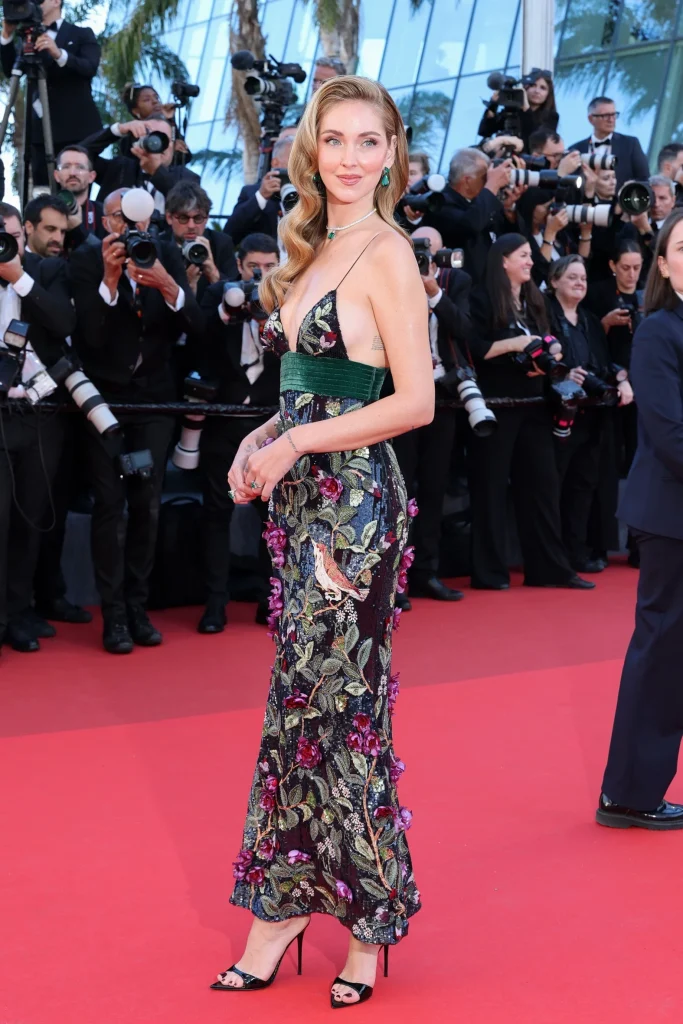
This shift also helps explain why personalities such as Chiara Ferragni continue attracting attention far beyond social media numbers. Ferragni entered public life as a digital personality and later moved into business, fashion, publishing, and international partnerships. Years ago, the idea of influencers occupying the same cultural territory as actresses and fashion icons generated debate. That conversation has largely disappeared.
On May 17, during the screening of Garance at the 79th Cannes Film Festival, Ferragni appeared wearing a Roberto Cavalli Archive creation by Fausto Puglisi. The choice immediately felt connected to Cannes itself — theatrical without appearing excessive, highly detailed yet controlled.
The dress drew inspiration from ramage motifs rooted in bucolic paintings discovered in Pompeii. Historical references often remain hidden inside fashion, though occasionally they become central to a garment’s identity. Here, decorative elements moved beyond surface embellishment and entered storytelling territory.
The entire gown had been embroidered by hand. Threadwork, sequins, crystals, and specially shaped petals created layers across the surface, introducing texture and movement from every angle. Certain garments ask viewers to step closer. This was one of them.
The three-dimensional construction produced shifting visual effects depending on movement and light. Details appeared and disappeared while walking, creating changing impressions from photograph to photograph. The process felt closer to craftsmanship associated with couture ateliers than traditional red-carpet dressing.
A topstitched green velvet band introduced structure and shape through the waistline. Against the embroidery, the darker detail created contrast and rhythm. The eye moved naturally across the dress.
Archive fashion often creates an interesting conversation between past and present. Contemporary styling brings garments into a different moment while preserving their original identity. In Cannes, where nostalgia and image frequently meet, the idea feels particularly relevant.
Photos: Roberto Cavalli Press Office