Pop stars occupy a unique position in contemporary culture. Their influence extends far beyond music, shaping fashion, beauty, film, advertising, and the way entire generations express themselves. The most successful artists remain relevant because they continuously evolve while staying true to their artistic identity. Few performers have demonstrated that ability as consistently as Madonna.
For more than four decades, Madonna has remained one of the defining figures in popular music. Born in Michigan, she moved to New York City in the late 1970s with little more than ambition and determination, pursuing a career in dance before turning her attention to music. Her breakthrough arrived in the early 1980s with a succession of international hits that quickly established her as one of the world’s biggest recording artists. Albums including Like a Virgin, True Blue, Ray of Light, and Confessions on a Dance Floor became milestones in pop history, while songs such as Like a Prayer, Vogue, Frozen, and Hung Up continue to influence artists decades after their release. Throughout her career, Madonna has repeatedly reinvented her visual identity, introducing new styles that often became global fashion references. Her concerts transformed the scale of live pop productions, combining choreography, theatrical staging, fashion, and storytelling into large-scale performances. Beyond music, she expanded her career into film, publishing, directing, and business, proving that creative influence can extend across multiple industries. Her willingness to address social issues, challenge conventions, and support artistic freedom has made her one of the most discussed personalities in entertainment. At the same time, luxury fashion houses have consistently viewed Madonna as a source of inspiration, collaborating with her across campaigns, editorials, and public appearances. Even after more than forty years in the spotlight, her appearances continue to generate worldwide attention, confirming her status as one of the most recognizable women in contemporary culture. In 2026, she entered another chapter of her career by becoming Global Brand Ambassador for KIKO Milano while preparing the release of her new album Confessions II, once again placing music and fashion at the centre of the conversation.
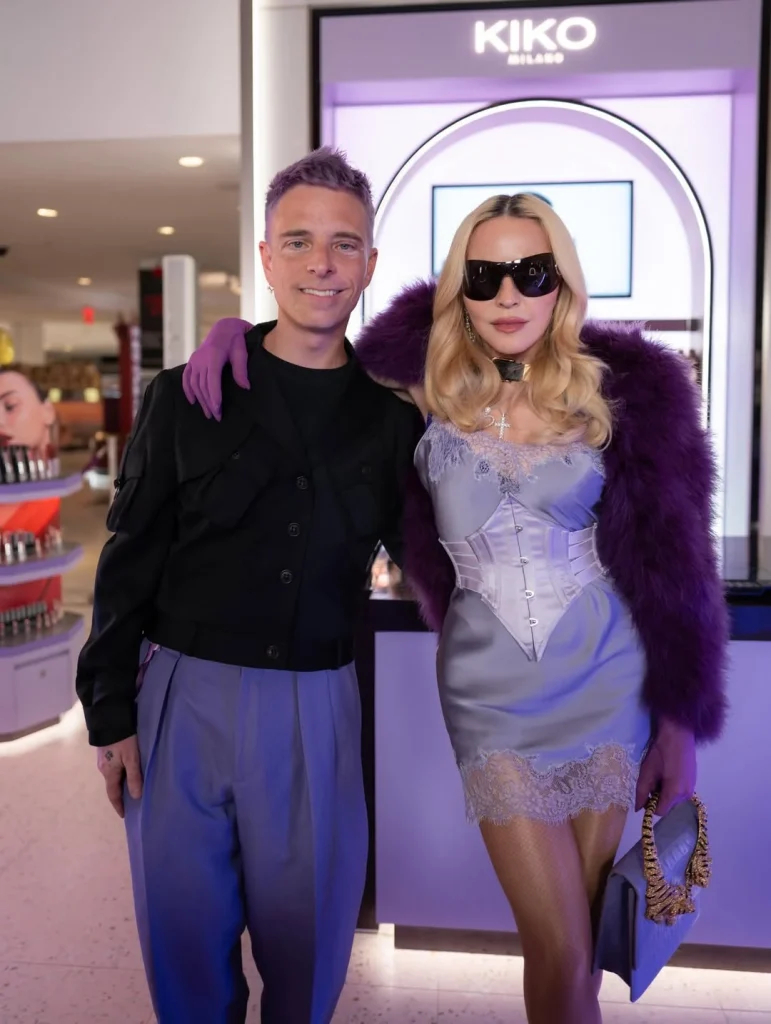
Fashion has always played an important role in Madonna’s public image, and her appearance at the “On The Dance Floor” celebration hosted by KIKO Milano at Macy’s Herald Square in New York on 8 June 2026 offered another example of her long-standing relationship with Italian design. For the occasion, she carried the Roberto Cavalli Roar Bag in a delicate pastel purple, introducing one of the house’s newest accessories to an international audience. Roberto Cavalli has long built its identity around Italian craftsmanship, distinctive textures, animal-inspired details, and confident femininity, establishing itself as one of the country’s best-known luxury fashion houses. Founded by Roberto Cavalli in Florence in the early 1970s, the brand gained international recognition through innovative textile techniques and a strong visual identity that attracted celebrities, musicians, and collectors around the world. The Roar Bag continues this direction while presenting a contemporary interpretation of the house’s design language. The soft pastel shade selected by Madonna contrasted with her monochromatic purple look, demonstrating how accessories can become the defining element of an entire outfit. Public appearances such as this remain significant for luxury brands because they introduce new collections through personalities whose style continues to influence audiences across generations. Madonna’s choice once again illustrated the close relationship between music, fashion, and Italian luxury, while Roberto Cavalli reaffirmed its place among the labels regularly chosen by internationally recognised cultural figures.